


KickStart: Encourage 2-way communication with simple paperwork. Then instead of blowing up, praise your people when they give you a “heads up” before things hit the fan! Read on…
Normally, I love a good surprise. In fact, I keep dropping heavy-handed hints about a surprise anniversary party! 🎈🎊🎉💖
So far... absolutely zero takers. My family and friends are clueless! 🥹
But in a residential services business? Surprises are your worst enemy! 🫣 Here’s why I hated surprises in my company…
Too often an employee would sandbag me with a problem right at the end of the day. Worse, I’d get bushwhacked with a surprise call from a furious homeowner. 😠
Or disaster would strike 💀 when I (and potentially 1000’s of potential clients) learned about a pissed off client (that had never complained to us) from their nasty 1-star review on Google! 😡
Just like in a healthy family, success in a residential services business boils down to Clear, Honest, and Open Communication between… your customers, field techs, office staff, managers and YOU!
Steve’s BTW: This “Clear, Honest, and Open Communication” principle even helps in marriage. 😦 (Sioux and I call if “C-H-O-Colate” and we’re still working on it after 51+ years together!) 😍
Therefore, I would appeal to my employees: “Folks, there is nothing we can’t overcome IF you let me know about the issue AHEAD of time.”
And yet, the nasty surprises kept popping up due to our lack of communication! It was time to search for answers along with some tough, self-introspection on my part…
I discovered the nasty surprises in our company were due to a 2-part problem. The first issue? My staff was frightened to share problems and bad news with me since I would blow up! OUCH!
My solution? I made a painful 🥹 and very heartfelt apology to my employees and promised I would no longer “shoot the messenger” bearing the bad news!
I also begged everyone to help me get proactive in solving not only the immediate problem but also the systemic failures that led to the issue.
In other words, I needed every employee to focus not only on the “HOW do we get out of this?” but also “WHY are we here?” and most importantly, “WHAT can we change to make sure it never happens again?”
NOTE: This HOW-WHY-WHAT equation deserves its very own future KickStart!
So, when your employees give you a heads-up on a problem, immediately thank them! Even if they were the ones who screwed up and you really want to rip some heads off! 😡
At least you’ve been warned and can perform damage control BEFORE the customer goes nuclear with a 1-star review. Now for my second solution to my 2-part “ugly surprises” problem…
I realized to bake this open 2-way communication into my company’s DNA, I needed to “Make it easier to do it right than to do it wrong”! You can follow my lead when you…
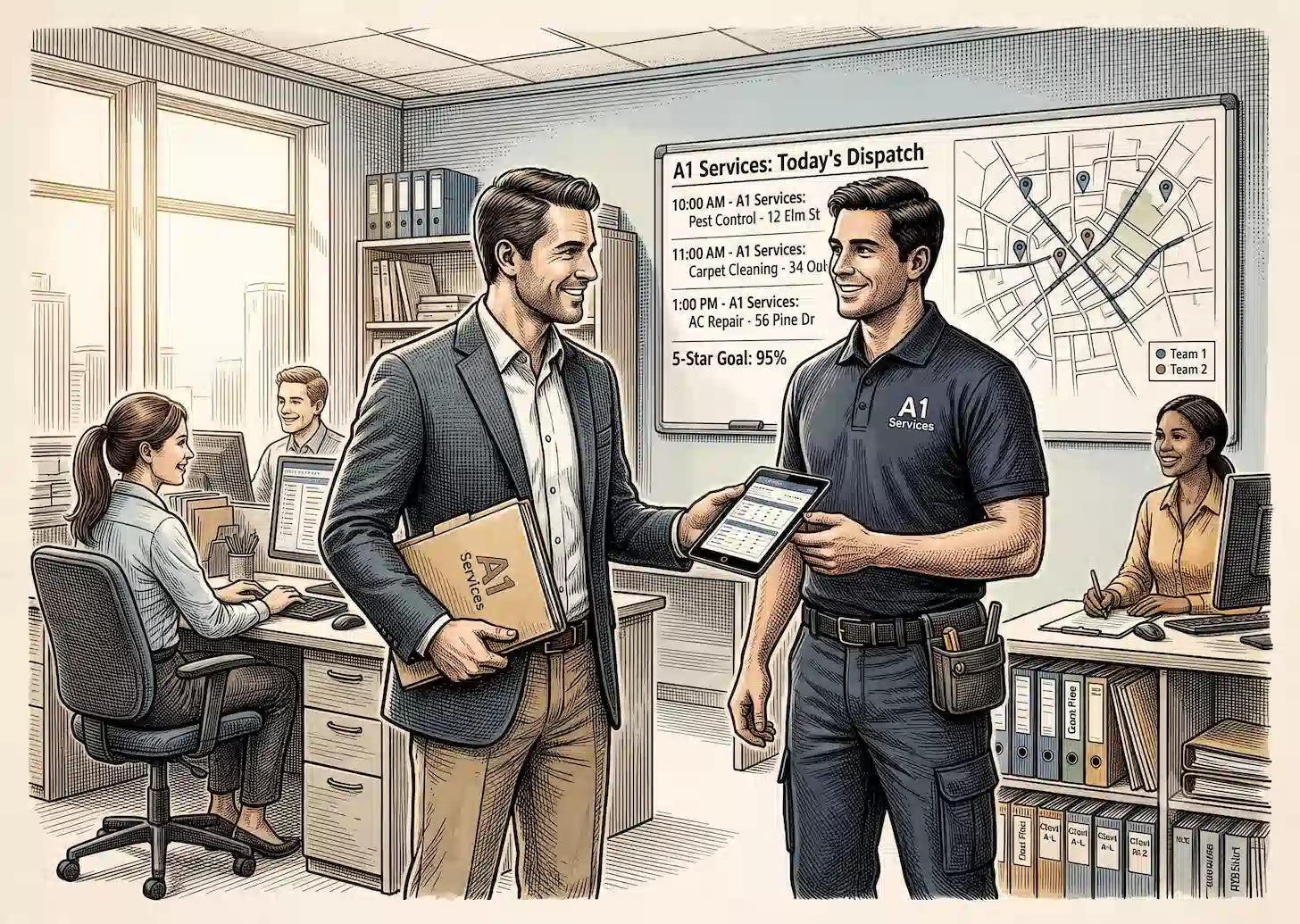
Implement a simple “Production Day Sheet” (PDS) dispatch form.
First, do me a favor. Ditch the complicated software and develop a “day at a glance” Production Day Sheet (PDS). Heck, I scrawled out my first PDS prototype with pen and paper! (I still do this for the forms I create.)
Whether you hand your crew a clipboard or pull it up on a tablet, your Production Day Sheet (PDS) needs the basics: addresses, arrival windows, and any special non-inventory equipment to load up for the job.
But the real PDS magic is in the customer intel before your tech drives up to the job. Special requests or access info should always be front and center: “Put the ankle-biter dog in the backyard,” or “Mrs. Jones at Apt. 2C works night shift, do NOT ring the doorbell.”
This “heads-up” info helps your techs respect the sanctity of a customer’s wishes and their feelings. In turn, clients’ defensive emotional walls come down, trust goes up and a positive relationship blossoms! 💖
NOTE: Remember, the PDS only gives your employees the “big picture.” It’s your core document for daily communication. The nitty-gritty job details and pricing should always live on a separate Work Order for each stop.
The Rule of “Follow Up, Not Freak Out” Your techs use this sheet to jot down any potential hiccups or promises they made to the homeowner, so the office can follow through. However...
The PDS dispatch form is NOT for emergencies! With residential work especially, any quality problems or accidents like denting a drywall corner (don’t even ask!) 🙄 should be phoned in immediately upon leaving the job! Here’s why…
You want to address the issue with an Immediate Quality Check call. (Ideally you can bring the concern even before the homeowner notices it.)
Either way, the goal is to solve the problem before the client even has time to get mad and/or post a nasty 1-star review! 👍👍
A Quick Tip for Commercial Accounts If you run regular commercial routes, each account should have its own Commercial Account Profile (CAP).
Develop a separate CAP list of all the alarm codes, gate access info, and specific cleaning tasks for each building.
Then, simply attach all the CAPs for that shift to their daily (actually “nightly”)😁 PDS sheet so your tech is never left standing in a dark parking lot at 3:00 AM… calling YOU! 😎